
How to Always Have Something to Wear When You Have No Fashion Instinct
You stand in front of a full closet and feel nothing. Not overwhelmed, more like stranded. You own clothes. You are a functioning adult. And yet every morning ends the same way: the same three things you always wear, or a scramble that leaves you feeling vaguely wrong all day.
This is not a motivation problem. It is not a self-discipline problem. It is a systems problem, and systems can be solved.
The fashion industry has a financial interest in convincing you that getting dressed is an art, that some people have “it” and others never will, that the solution is always more pieces, more inspiration, more scrolling. None of that is true. Getting dressed consistently well is a skill built on a small number of repeatable principles. Once you understand them, the mystery dissolves. The closet stops being a source of low-grade dread.
Here is the formula.
The Problem Is Not Your Clothes. It’s the Absence of a Decision Architecture.
Fashion-fluent people do not make better decisions than you. They have internalized a set of rules so thoroughly that the decisions appear effortless. What looks like instinct is pattern recognition that happened to develop early, usually through proximity, a particular parent, a particular social environment, a particular amount of trial and error they were permitted to make without financial consequence.
You probably didn’t have that runway. Most analytically wired people didn’t. The good news is that the patterns are learnable, and they are far simpler than the industry wants you to believe.
The decision architecture you need has three layers: a correct inventory, a reliable filter, and a fast daily system. Miss any one of these and the whole thing breaks down. Most people who “can’t get dressed” are failing at the inventory level – they own the wrong things, or the right things in the wrong quantities – and no amount of morning willpower will fix an upstream problem.
Start With an Audit, Not a Haul
Before you buy anything, you need to know what you’re actually working with. Pull everything out. Not to Marie Kondo it but to assess it the way an engineer would assess a system before troubleshooting. You are looking for three categories of failure:
Items that don’t fit your body right now are not aspirational. They are decision-friction. Every morning you touch them and put them back is a small cognitive tax. Remove them from the equation.
Items that have no logical partners, a statement top that goes with nothing, a shoe that requires one specific outfit, etc are dead weight regardless of how much you paid for them. A piece that can’t work in at least three combinations is an indulgence the closet can’t afford.
Items in colors that work against your natural coloring are the most insidious problem because they often look fine on the hanger and wrong on your body, and you can never quite diagnose why. That diagnosis comes later.
What remains after this audit is your actual working wardrobe. For most people it is smaller than they expected and more coherent than they believed. That is not a failure. That is a starting point.
The Math Behind “Always Having Something to Wear”
The feeling that you have nothing to wear is rarely about volume. It is about combinability. A wardrobe of forty pieces that don’t talk to each other produces fewer functional outfits than a wardrobe of twenty pieces that do.
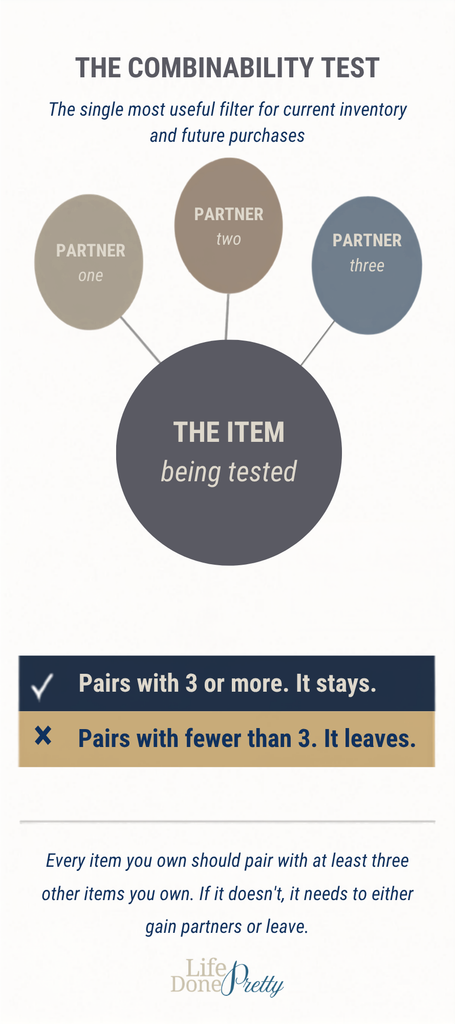
The formula is this: every item you own should pair with at least three other items you own. If it doesn’t, it needs to either gain partners or leave. This is the combinability test, and it is the single most useful filter for future purchases as well as current inventory.
The specific quantities – how many tops, how many bottoms, how many shoes – depend on your lifestyle and how often you do laundry. But the ratio matters more than the number. A roughly 2:1 ratio of tops to bottoms gives you the most outfit permutations for the least closet space. Shoes anchor more than people realize, which is why they deserve particular attention in the formula.
A wardrobe built on combinability is also a wardrobe that’s resilient to bad days. When everything goes with everything, you cannot make a catastrophic error. You can only make choices along a spectrum of good to slightly better.
Your Color Filter Is the Fastest Way to Eliminate Bad Decisions Before They Happen
Here is what actually happens when an outfit looks wrong: most of the time, it is a color problem. Not a fit problem, not a proportion problem; the colors are pulling against each other or against you.
Everyone has a natural coloring in their skin tone, hair, and eyes that interacts with colors in predictable ways. Some colors make you look rested. Others make you look tired. This is not subjective. It is physics: warm undertones in skin are flattered by warm undertones in color, cool undertones by cool colors. The pattern is consistent enough to systematize.
You do not need to pay for a color analysis appointment to understand your palette. You need a window with natural light, a range of fabric swatches or existing clothing, and about forty-five minutes of honest observation. The colors that make your face look more alive are your colors. The ones that drain it are not. Once you know this, roughly half of all shopping mistakes become impossible to make.
Within your wardrobe, build around three to five anchor colors that you’ve confirmed work on your body. They don’t all need to match each other, they need to be connectable, meaning a single neutral can bridge any two of them. This is how a small wardrobe produces a large number of combinations.
P.S. The self-assessment above will get you to the right color family — warm or cool, light or deep, clear or muted. A trained color analyst takes that one step further, placing you precisely within one of twelve seasonal results: True Spring, Light Spring, Bright Spring, True Summer, Light Summer, Soft Summer, True Autumn, Soft Autumn, Dark Autumn, True Winter, Bright Winter, or Dark Winter. Each of the twelve has a specific palette — not just a direction, but a curated set of shades, neutrals, and accent colors calibrated to your exact coloring. If the DIY method gives you a working palette, professional analysis gives you a complete one. For a reader who has spent years making color mistakes, that precision is worth the investment.
Fit and Proportion Are the Invisible Difference Between Polished and Assembled
Two people can own the same pieces and produce radically different results. The difference is almost always proportion: the relationship between where clothing hits the body, how volume is distributed, and which part of the body is being emphasized or receded.
The blunt truth is that most clothes off the rack are proportioned for a theoretical average body, and almost no actual bodies are average. Hemlines that hit at the widest part of the calf make legs look shorter. Jackets that end at the hip create horizontal interruption at a point that breaks the visual line of most torsos. These effects are not about the clothes being “unflattering” in some vague sense, they are about specific geometry that can be identified and corrected.
Every body has what a tailor would call an anchor point – a proportion that the eye reads first and that other proportions are measured against. Dressing to support that anchor point, rather than accidentally fighting it, is what separates clothes that look intentional from clothes that look like they happened.
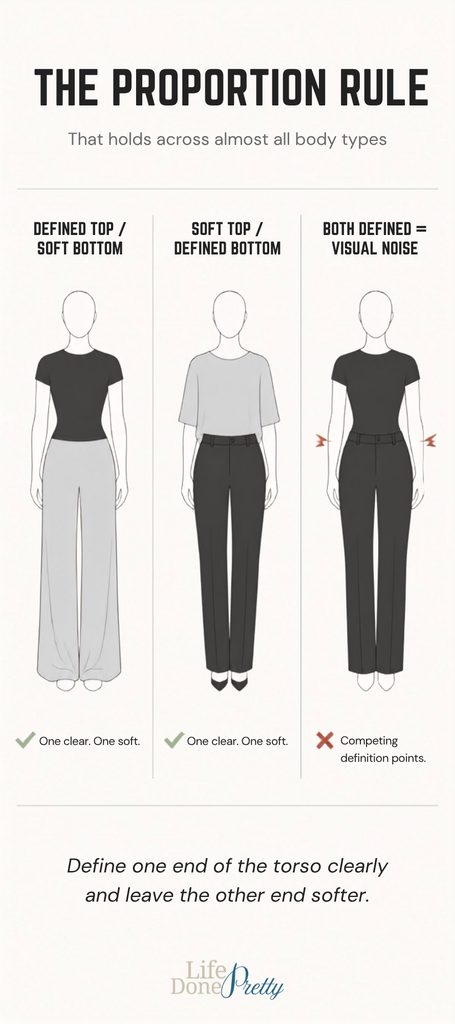
The rule that holds across almost all body types: define one end of the torso clearly and leave the other end softer. Trying to define both simultaneously creates visual noise. Trying to obscure both creates visual confusion.
Build Outfits Backwards from the Hardest Piece
Here is the sequence error that creates most morning failures: people start with the item they want to wear and then search for pieces that go with it. When the item they want to wear is something interesting, a print, a statement shoe, an unusual color, the search for compatible pieces fails because nothing was purchased with those pieces in mind.
The backwards method inverts this logic. Start with the most specific item in your wardrobe – the piece with the fewest possible partners – and build around it. For most people, that piece is shoes.
Shoes are the hardest item to make work because they are specific in color, finish, and formality register in ways that tops and bottoms are not. A brown leather ankle boot has a narrower set of compatible partners than a grey sweater does. If you identify your shoes first, the rest of the outfit is a process of elimination rather than a creative problem.
This approach also changes how you shop. When you know that a new shoe needs to work with at least three existing outfits before it earns a place in your closet, impulse purchases become impossible to rationalize. The shoe either passes the test or it doesn’t, and the test has no feelings about how beautiful it looked on the display.
The Daily System: Three Items, Under Five Minutes
All of the above, the correct inventory, the color filter, the proportion awareness, the backwards build is setup work. You do it once, update it occasionally, and then stop thinking about it. The daily system is what converts that setup into actual mornings that work.
The 3-Item Rule is the daily mechanism. Every outfit is anchored by exactly three items chosen in sequence: a bottom, a top, and a layer or a shoe. Not five items, not “an outfit with accessories built in.” Three items, in that order, from your pre-edited, combinability-tested wardrobe.
The reason this works is that three items is the minimum needed to create a complete, proportionally considered look, and the maximum you can evaluate in under five minutes without decision fatigue. Beyond three, you are styling. Under three, you are half-dressed. Three is the productive middle.
The rule also functions as a constraint that forces clarity. When you can only choose three things, you cannot bury a proportion mistake under accessories. You cannot talk yourself into a fourth piece that “fixes” a combination that was never right. The limit makes the system honest.
The Formula, Assembled
Getting dressed consistently well is not the result of taste, confidence, or inspiration. It is the result of a wardrobe that has been built with intentional constraints, filtered through a reliable color system, constructed with attention to proportion, and executed through a fast, repeatable daily protocol.
Correct the inventory. Establish your color filter. Understand your anchor point. Build backwards from your most specific piece. Apply the three-item rule every morning.
The closet that felt like a problem was never a problem of having too little. It was a problem of having no system to work with what you had.
A formula replaces the need for instinct.
Frequently Asked Questions
Almost certainly a combinability problem rather than a volume problem. When pieces don’t connect to each other — different color families, no shared formality register, items with only one possible partner — the wardrobe produces fewer functional outfits than the item count suggests. The audit described in this post is the diagnostic: pull everything out, apply the three-combination test to each piece, and identify what is sitting in isolation. The solution is rarely more clothes. It is usually removing the pieces that are breaking the system and making targeted additions that create new connections.
No. Fashion instinct is pattern recognition that developed through early exposure and repeated trial and error — it is not an innate trait, and it is not required. The formula in this post replaces instinct with a decision architecture: a correct inventory, a color filter, proportion awareness, a backwards build sequence, and a daily three-item rule. Each of these is a learnable skill with specific, repeatable steps. The people who appear to have instinct have simply internalized these patterns without being taught them explicitly. You are learning them explicitly, which is faster.
Start with the audit and nothing else. Do not buy anything, do not reorganize anything, do not attempt the color filter or proportion work until you know what you are actually working with. The audit takes one focused session and produces immediate clarity — most people discover that their functional wardrobe is smaller and more coherent than they believed, which makes every subsequent step easier. The system is sequential for a reason: each layer builds on the one before it, and skipping to the daily rule before correcting the inventory produces the same morning failures as before.
Most capsule wardrobe content hands you a number — ten tops, five bottoms, three shoes — without explaining the logic behind it or accounting for the fact that your life is not average. This formula starts from your actual variables: your laundry cycle, your occasion map, your re-wear tolerance, your specific body’s proportion geometry. The number you land on is derived from your inputs, which means it fits your life rather than a theoretical one. The result is a wardrobe that works on a bad week, not just a good one.
The audit is specifically designed for this situation. Expensive mistakes are pieces that failed the combinability test — they had no partners, or the wrong color, or a proportion that fought the rest of what you own. Identifying them clearly is the first step to stopping the pattern. The formula gives you a purchasing filter going forward: any new piece must pair with at least three items you already own before it earns a place in the wardrobe. That single rule makes the category of expensive mistake structurally impossible to repeat.
The audit is one session of two to three hours depending on wardrobe size. The color filter work takes roughly forty-five minutes in good natural light. The proportion and anchor point assessment is another hour of focused observation. The backwards build sequence and three-item rule become habitual within two weeks of daily practice — after that they take under five minutes each morning. The total front-loaded investment is a single focused weekend. The daily return on that investment is a morning that no longer requires decisions.
Yes, with one adjustment: the audit needs to be repeated when a body change is significant enough to affect fit. Clothes that no longer fit correctly are not aspirational — they are decision friction that breaks the system every morning you touch them. Remove them from the active wardrobe without guilt. The formula works on the body you have right now, not the body you expect to have. When your body changes again, run the audit again. The system is designed to be updated, not set once and abandoned.